Elevating Visual Storytelling: Why the Crafter Creative Presentation Template Matters in Modern Business
In an era defined by digital saturation and fleeting attention spans, the ability to communicate complex ideas with clarity and aesthetic precision has never been more critical. For professionals, entrepreneurs, and creatives, a presentation is no longer merely a vessel for information; it is a strategic asset that defines brand perception and influences decision-making. This shift in communication dynamics has elevated the demand for tools that bridge the gap between high-end design and practical functionality. Enter the Crafter Creative Presentation Template, a solution designed not just to display content, but to enhance the narrative architecture of modern business storytelling.
The introduction of the Crafter Creative Presentation Template arrives at a pivotal moment in the creative economy. As remote work solidifies and hybrid collaboration becomes the norm, visual assets must perform harder than ever before. Stakeholders expect pitch decks, company profiles, and portfolios to possess the polish of a dedicated design agency while remaining editable by non-designers. This template addresses that specific friction point, offering a versatile framework that serves creative agencies, startups, corporate entities, photographers, and personal brands alike. By understanding why this tool resonates with current market needs, we can better appreciate how it fits into the broader ecosystem of professional communication.
The Convergence of Design Accessibility and Professional Standards
Historically, there has been a stark divide in presentation design. On one side stood expensive, custom agency work that was visually stunning but difficult to update. On the other sat generic, rigid templates that sacrificed brand identity for convenience. The current market trend favors a middle ground: modular design systems that offer bespoke aesthetics without the technical debt. The Crafter Creative Presentation Template exemplifies this evolution by utilizing a Master Slide-based architecture. This approach is significant because it mirrors the workflow of professional UI/UX designers, allowing users to make global changes across multiple slides instantly.
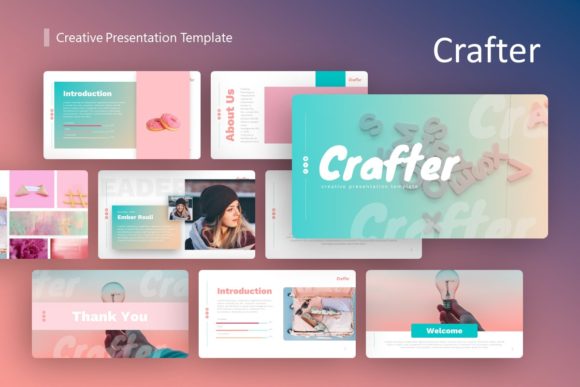
This structural sophistication matters because it respects the user's time while maintaining visual integrity. When a startup founder needs to pivot their pitch deck hours before a meeting, or when a photographer needs to swap out portfolio images for a specific client proposal, the underlying grid and typography must remain intact. The template provides 36 distinct slides per variation, ensuring that whether the goal is a data-heavy corporate report or a minimalist personal portfolio, the visual language remains consistent. This consistency is key to building trust; in a landscape where consumers and investors are increasingly design-literate, visual coherence signals organizational competence.
Adapting to the Multi-Hyphenate Professional Workflow
The modern workforce is increasingly composed of multi-hyphenate professionals. A freelancer might be a strategist, designer, and writer simultaneously. A startup CEO acts as product manager, sales lead, and visionary. These individuals do not have the luxury of switching between disparate software ecosystems for every task. They require tools that integrate seamlessly into existing workflows. The fact that Crafter is handcrafted in PowerPoint (.PPTX) is a deliberate and strategic choice that aligns with enterprise realities.
While newer design tools have gained popularity, PowerPoint remains the lingua franca of global business. By anchoring the template in this ubiquitous format, Crafter ensures compatibility across organizations. However, it pushes the boundaries of what the software can achieve through pixel-perfect illustrations and fully resizable vector graphics. This allows a marketing team to create infographics that look like they were rendered in Adobe Illustrator, yet remain fully editable within the presentation environment. This reduction in tool-switching friction directly impacts productivity, allowing creators to focus on message refinement rather than file conversion or formatting repairs.
The Strategic Value of Handcrafted Infographics
Data visualization is no longer optional; it is a primary mode of persuasion. Yet, many presentations fail because they rely on default chart styles that lack context or engagement. The inclusion of handcrafted infographics within the Crafter Creative Presentation Template speaks to a growing need for bespoke data storytelling. In an age of AI-generated content, human-centric design elements carry a premium. Handcrafted visuals suggest care, intentionality, and expertise—qualities that automated tools often struggle to replicate authentically.
For corporate users and pitch deck creators, these infographics serve as cognitive anchors. They transform abstract metrics into tangible narratives. Because all graphics are resizable and editable, users can adapt these visual metaphors to their specific datasets without breaking the design. This flexibility supports a more agile approach to business intelligence, where insights can be visualized and iterated upon rapidly. Furthermore, the drag-and-drop picture placeholders streamline the process of integrating proprietary photography or product shots, ensuring that the final output feels personalized rather than templated.
Versatility as a Response to Market Fragmentation
Niche specialization is a dominant trend in today’s economy, yet successful professionals often need to operate across multiple verticals. A creative agency might pitch to a tech startup one day and a fashion label the next. A consultant might need a corporate profile for institutional clients and a personal portfolio for speaking engagements. The versatility of the Crafter Creative Presentation Template is a direct response to this fragmentation. By supporting use cases ranging from Photography and Portfolio to Startup Pitch Decks and Company Profiles, it functions as a comprehensive visual operating system.
This adaptability reduces the total cost of ownership for creative assets. Instead of purchasing separate templates for different business units or projects, organizations can standardize on a single, robust system that scales with their needs. This standardization also aids in brand governance. When teams use a unified set of master slides and vector icons, the risk of brand dilution decreases. The included documentation file further supports this by acting as a style guide, ensuring that even new team members can produce on-brand materials immediately. In a distributed work environment, such self-contained guidance is invaluable for maintaining quality control without constant oversight.
Future-Proofing Through Editable Vector Assets
Sustainability in digital design is about longevity and reusability. Raster-based templates degrade over time as screen resolutions increase and aspect ratios shift. The emphasis on vector iconography and resizable graphics in Crafter ensures that the asset remains viable regardless of future display technologies. Whether presenting on a 4K conference screen or sharing a PDF via mobile, vector assets maintain crispness and clarity. This forward-looking technical foundation protects the user’s investment.
Moreover, the editability of these vectors empowers users to evolve the template alongside their brand. As design trends shift toward bolder typography or softer color palettes, the template can be adjusted without requiring a complete redesign. This malleability is essential for businesses that view their visual identity as a living entity rather than a static artifact. It acknowledges that while the structure of good design is timeless, the expression of it must remain fluid.
Practical Considerations for Implementation
While the features of the Crafter Creative Presentation Template are extensive, its true value is realized through thoughtful implementation. Users should approach this tool not as a shortcut, but as a foundation. The 36 slides provided are a menu of possibilities, not a mandatory sequence. Effective storytellers will curate and rearrange these components to serve their specific narrative arc. The easy customizable contents allow for rapid prototyping of ideas, enabling teams to test different story structures before committing to a final version.
It is also important to note the distinction regarding imagery. As stated in the product details, all images in the demo are for preview purposes only and are not included in the files. This transparency is actually a benefit; it forces users to invest in authentic, high-quality photography that reflects their actual brand rather than relying on stock clichés. The drag-and-drop placeholders make integrating this original content seamless, but the requirement to source real images ensures the final presentation retains authenticity. In a market weary of generic stock aesthetics, this constraint encourages better creative outcomes.
Redefining Efficiency in Creative Communication
Ultimately, the relevance of the Crafter Creative Presentation Template lies in its ability to harmonize conflicting demands. It balances artistic freedom with corporate structure, individual expression with brand consistency, and creative aspiration with technical limitation. For the entrepreneur pitching to investors, it provides the credibility of professional design. For the photographer showcasing work, it offers a clean, unobtrusive gallery. For the corporate trainer, it delivers engaging educational visuals.
As we move further into a visually driven economy, the tools we use to shape our messages become extensions of our professional capabilities. Choosing a template is no longer a trivial administrative task; it is a strategic decision about how one wishes to be perceived. By leveraging a system built on master slides, vector scalability, and versatile application, professionals can ensure that their ideas are not just seen, but understood and remembered. The Crafter Creative Presentation Template stands as a testament to the idea that great design should not be a barrier to entry, but a catalyst for clearer, more impactful communication. In adopting such tools, creators and businesses signal their commitment to excellence in an increasingly noisy world, turning every slide into an opportunity for meaningful connection.