Designing with Empathy: How the Mindfull Presentation Template Enhances Mental Health Communication
Communicating complex topics related to psychology, wellness, and corporate well-being requires a delicate balance between clinical accuracy and emotional resonance. When professionals present data on mental health, startup pitch decks for wellness apps, or personal portfolios for therapists, the visual medium is just as important as the spoken word. The Presentation Template - Mindfull was engineered specifically to bridge this gap, offering a structured yet flexible framework that respects the sensitivity of the subject matter while maintaining professional rigor. This resource serves as more than a collection of slides; it acts as a visual translator for nuanced conversations across creative agencies, educational institutions, and healthcare providers.
The Intersection of Visual Psychology and Slide Architecture
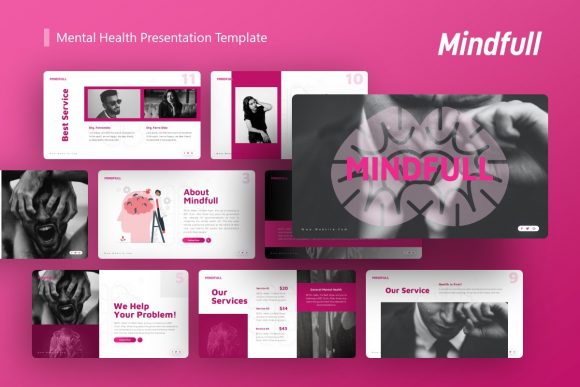
Effective presentation design in the mental health sector must adhere to principles of cognitive ease. Audiences processing information about stress, trauma, or organizational health are often in a state of heightened sensitivity. Cluttered layouts, aggressive color schemes, or inconsistent typography can create subconscious friction that detracts from the message. The Mindfull template addresses this through a master slide system that enforces visual harmony. By utilizing pixel-perfect illustrations and handcrafted infographics, the design reduces cognitive load, allowing the audience to focus entirely on the narrative rather than deciphering chaotic visuals.
The architecture of this template relies on 36 distinct slides per variation, providing a comprehensive library of layouts without overwhelming the user. This breadth ensures that whether a presenter needs to display quantitative research data, qualitative patient testimonials, or strategic business roadmaps, there is a pre-designed container that maintains the overall aesthetic integrity. The consistency achieved through master slides builds trust; when an audience perceives order and care in the visual delivery, they are more likely to extend that perception of care to the speaker and the content itself.
Adapting the Framework Across Diverse Professional Sectors
While rooted in mental health themes, the utility of the Presentation Template - Mindfull extends far beyond clinical settings. Its versatility stems from a neutral yet warm design language that adapts to various professional contexts without losing its core identity.
- Creative Agencies and Portfolios: For designers and photographers focusing on wellness brands or human-centric projects, the template offers picture placeholders optimized for high-impact imagery. The drag-and-drop functionality allows creatives to showcase work within a layout that feels intentional and curated rather than generic.
- Corporate Wellness and HR: Businesses introducing Employee Assistance Programs (EAPs) or diversity initiatives require a tone that is professional yet approachable. The included infographics allow HR teams to visualize participation rates, survey results, and program benefits clearly, transforming dry statistics into compelling narratives of organizational health.
- Startups and Pitch Decks: Founders in the digital health space face the challenge of proving both market viability and social impact. This template provides specific slide structures for problem-solution fit, market analysis, and team introductions that signal empathy and competence simultaneously to potential investors.
- Educational Researchers: Academics presenting at conferences need to balance dense text with visual engagement. The resizable graphic elements and clean typography ensure that citations, methodology charts, and theoretical models remain legible and aesthetically pleasing during lectures or peer reviews.
Technical Customization and Workflow Efficiency
A common criticism of niche presentation templates is that they are too rigid, forcing users into a specific box that limits creativity. The Mindfull template counters this through its emphasis on editability and technical accessibility. Built on PowerPoint .PPTX architecture, it leverages native features that most professionals already understand, eliminating the learning curve associated with proprietary design software.
The "handcrafted infographic" feature is particularly significant for workflow efficiency. Rather than building charts from scratch or importing static images from external sources, users can modify data directly within the slide environment. Because these graphics are vector-based and fully editable, they scale infinitely without pixelation, ensuring that presentations look crisp on everything from laptop screens to large-format conference projectors. This scalability is essential for modern hybrid work environments where content is consumed across devices of varying resolutions.
Furthermore, the inclusion of a documentation file and vector icon set streamlines the customization process. Users are not left guessing how to alter color palettes or replace placeholder assets. The documentation serves as a technical guide, ensuring that the template remains a time-saving tool rather than a source of frustration. This attention to user experience reflects the same mindfulness applied to the visual design, respecting the presenter's time and technical constraints.
Strategic Content Organization Through Master Slides
The structural backbone of any successful presentation is consistency, and this is managed most effectively through master slides. In the context of the Presentation Template - Mindfull, master slides do more than store logos and fonts; they encode the visual rhythm of the presentation. When a user adds a new slide, the inherited formatting ensures that margins, text hierarchy, and spacing align perfectly with previous content. This automated alignment prevents the subtle visual drift that often occurs when multiple stakeholders collaborate on a single deck.
For mental health professionals, this structural reliability supports ethical communication. It ensures that sensitive content is always framed appropriately, preventing accidental formatting errors that could trivialize serious topics. For example, a slide designed for patient stories will have different padding and typography than a slide designed for financial projections. The master slide system preserves these distinctions automatically, guiding the presenter toward appropriate visual treatments for different types of information.
Navigating Asset Management and Licensing Considerations
When integrating third-party templates into professional workflows, understanding asset licensing and file composition is critical for compliance and quality assurance. Users of the Mindfull template should note that all images displayed in preview demos are for illustrative purposes only and are not included in the downloadable files. This distinction is vital for avoiding copyright infringement and managing expectations.
This exclusion actually benefits the end-user by encouraging the use of authentic, licensed, or original photography. Stock photos in mental health presentations can sometimes feel performative or stigmatizing if chosen poorly. By requiring users to insert their own imagery via the designated picture placeholders, the template promotes authenticity. Organizations are encouraged to use real photos of their facilities, team members, or properly licensed inclusive stock imagery that accurately represents their specific community and values.
The deliverables include the PowerPoint .PPTX file, comprehensive documentation, and a vector icon pack. These components form a complete ecosystem. The vector icons are particularly valuable as they provide a cohesive symbol library that matches the template’s line weight and style. Using mismatched icons from disparate sources is a common design error that undermines professionalism; having a dedicated set ensures that every bullet point, process diagram, and contact slide maintains visual unity.
Optimizing Narrative Flow for Sensitive Topics
Beyond aesthetics and technical specs, the true value of the Presentation Template - Mindfull lies in its ability to shape narrative flow. Presenting on mental health or personal portfolios requires a non-linear approach that honors complexity. The 36-slide variety allows presenters to construct narratives that breathe. Instead of wall-to-wall text, users can intersperse data-heavy slides with minimalist quote cards, full-bleed photography, or abstract graphic breaks.
This pacing is essential for audience retention and emotional regulation. In a corporate setting discussing burnout, for instance, following a dense chart on productivity loss with a calming, visually simple slide allows the audience to process the information before moving forward. The template provides the tools to engineer these pauses naturally. The resizable graphics and editable contents mean that no two presentations need to follow the exact same cadence, even if they use the same underlying assets.
Ultimately, selecting a presentation tool is a strategic decision about how information is received. For topics involving human well-being, creativity, and personal identity, the vessel matters as much as the substance. The Mindfull template offers a specialized environment where design serves empathy, efficiency supports clarity, and technical flexibility enables authentic storytelling. Whether used for a high-stakes investor pitch, a therapeutic workshop, or a creative portfolio review, it provides the foundational structure necessary to communicate with both precision and heart.